Personalized Medical Care & Dedicated International Patient Concierge


Medical Guide
What Is 4D Facial Liposuction? Definition & Basics
4D facial liposuction uses area-specific fat-layer separation and a 3D contouring approach to refine the jawline and cheeks at Sharp Plastic Surgery.
Schedule a ConsultationWhat Is 4D Facial Liposuction? A Clear Definition
Medically reviewed by Dr. Kim Un-hoe, Board-Certified Plastic Surgeon, Sharp Plastic Surgery · Last updated July 2026
If you are asking what 4D facial liposuction is, here is the direct answer. 4D Facial Liposuction is a facial contouring procedure that Sharp Plastic Surgery describes using two documented ideas: area-specific fat-layer separation and treatment, and a three-dimensional facial contouring approach. In plain terms, it is a form of facial fat liposuction that aims to refine defined areas such as the jawline and cheeks by treating fat in a targeted, layered way rather than removing volume uniformly. At Sharp Plastic Surgery it is offered as part of the clinic's facial fat liposuction and signature "Sharp Line" contouring philosophy, which relies on fat reduction rather than bone surgery or artificial implants. This article explains that definition in more depth, adds general medical background on how facial liposuction works, and points you to what to confirm during a personal consultation. Individual results vary.
4D Facial Liposuction Meaning: The Short Answer
The term "4D facial liposuction" is a descriptive name for a facial contouring technique, not a separate medical device category. At Sharp Plastic Surgery, the meaning is anchored to how the clinic documents the procedure:
- Area-specific fat-layer separation and treatment. The idea is to address fat in specific zones of the face and in a layered way, rather than treating the whole face as one flat area.
- Three-dimensional (3D) facial contouring approach. The goal is to consider the face as a three-dimensional structure — front, sides, and the transitions between them — so that changes look balanced from multiple angles.
In everyday language patients often call this "facial liposuction," "facial fat removal," or "V-line contouring." Within Sharp Plastic Surgery's own vocabulary, 4D Facial Liposuction sits inside the broader Sharp Line facial fat liposuction approach, which the clinic positions as a non-bone, non-implant way to refine facial lines. What "4D" is not: it is not a promise of a specific outcome, and it is not jaw-bone shaving or a filler injection. It is a fat-focused contouring method.
How Facial Liposuction Works: General Medical Background
To understand 4D Facial Liposuction, it helps to understand liposuction in general, using widely accepted medical education. Liposuction is a surgical procedure that uses suction to remove excess fat from specific areas of the body and to shape, or "contour," those areas, according to the American Society of Plastic Surgeons (ASPS) and Mayo Clinic. Both note that the face, cheeks, chin, and neck are among the areas that can be addressed. Importantly, liposuction is described as a contouring procedure, not a weight-loss method or a substitute for diet and exercise.
Facial fat is not a single flat pad. Medical references such as StatPearls describe subcutaneous fat as generally organized into a superficial fat layer and a deep fat layer, separated by a fascial system — in the face, this is related to the superficial musculoaponeurotic system, or SMAS. The deeper, more loosely organized fat is typically more responsive to suction, while the thinner, denser superficial layer requires more caution because over-treatment there can lead to contour irregularities. This layered anatomy is precisely why an approach built around "fat-layer separation and treatment" and three-dimensional planning is meaningful: the face has depth and structure, and contouring has to respect that.
The "4D" and Three-Dimensional Contouring Approach
The "3D contouring" language reflects a simple principle: the face is viewed from many angles. A jawline that looks refined from the front should also look natural in profile and three-quarter views. By planning treatment area by area and layer by layer, the aim is to keep transitions smooth — for example, between the lower cheek and the jawline — instead of creating a hollow in one spot or fullness in another.
This planning-first mindset is consistent with how Sharp Plastic Surgery describes its overall philosophy: precise diagnosis, meticulous technique, and individualized surgical planning based on each patient's facial structure. The clinic emphasizes enhancing a person's existing facial balance rather than following a single template. You can read more about that philosophy and the team on the clinic's about us page.
Where 4D Facial Liposuction Is Used on the Face
Sharp Plastic Surgery documents that 4D Facial Liposuction helps define areas such as the jawline and cheeks. More broadly, the clinic's facial fat liposuction approach is used to refine the cheeks, jawline, lower face, and area beneath the chin (often described by patients as a "double chin"). The intent is to reduce excess subcutaneous fat in these zones to support a more defined facial line while preserving natural proportions.
General references agree that the chin and neck region is a recognized area for liposuction contouring. That said, the specific pattern, amount, and technique for any individual are determined only after an in-person assessment of facial structure, fat distribution, fat thickness, and aesthetic goals — not from a web page.
How 4D Facial Liposuction Differs from Bone or Implant Contouring
A defining feature of Sharp Plastic Surgery's facial fat liposuction approach is that it is non-bone and non-implant. The clinic states its facial fat liposuction avoids artificial implants and works by refining fat and contour rather than altering the underlying facial skeleton. This matters because patients often confuse several very different categories of facial contouring:
- Fat-based contouring (facial liposuction, including 4D Facial Liposuction): reduces excess subcutaneous fat to refine lines such as the jawline and cheeks.
- Bone contouring surgery: reshapes the jaw or cheekbones themselves. This is a distinct, more invasive category and is not what facial fat liposuction does.
- Implant-based contouring: adds volume or projection using an artificial implant.
Understanding which category you are considering is one of the most useful things a consultation can clarify, because the recovery, risks, and suitability differ significantly among them.
Who Might Consider 4D Facial Liposuction?
Sharp Plastic Surgery frames candidacy through a one-on-one consultation and individualized facial analysis rather than a fixed checklist. In general, people who explore facial fat liposuction often have fuller cheeks or fullness beneath the jawline and would like more definition in the lower face while keeping a natural look.
General medical guidance adds important context on candidacy for any liposuction. ASPS and StatPearls note that good candidates typically have a stable weight and reasonable skin elasticity, and that liposuction is not a treatment for obesity. Skin quality matters, because skin needs to accommodate the new contour. A qualified surgeon also reviews your overall health and medical history. Whether 4D Facial Liposuction is appropriate for you specifically — and whether an alternative might suit you better — is a medical judgment made at consultation. You can start that conversation through the clinic's contact page.
What General Education Says About Recovery and Results
Sharp Plastic Surgery does not publish a fixed recovery timeline for facial fat liposuction, because recovery depends on the individual, the areas treated, and the personalized plan. General references give helpful expectations for liposuction overall: some swelling and bruising are normal afterward, swelling typically decreases over the following weeks, and the final contour becomes apparent only after swelling fully subsides — a process that can take weeks to months, according to Mayo Clinic and ASPS.
On results, general guidance notes that liposuction results can be long-lasting when body weight stays stable, but outcomes are individual. Sharp Plastic Surgery emphasizes gradual, natural-looking improvement in facial definition, monitored through structured follow-up. No responsible source promises a specific or guaranteed result, and results vary from person to person. Specifics about recovery, risks, anesthesia, and cost for your case are best confirmed directly during consultation. To see the kinds of outcomes documented by the clinic, you can review its before-and-after gallery.
The Bottom Line
- 4D Facial Liposuction is Sharp Plastic Surgery's facial contouring procedure defined by area-specific fat-layer separation and treatment and a three-dimensional contouring approach.
- It is a facial fat liposuction technique that helps define areas such as the jawline and cheeks, and it is non-bone and non-implant.
- Facial fat is organized in superficial and deep layers, which is why a layered, 3D-planned approach is used; liposuction is a contouring method, not weight loss.
- Candidacy, technique, recovery, risks, and cost are individualized and determined during an in-person consultation with Dr. Kim Un-hoe.
- Results vary by anatomy, skin quality, and healing; no outcome can be guaranteed.
Frequently Asked Questions
**Is 4D facial liposuction a special machine or a technique?**It is best understood as a facial contouring technique. Sharp Plastic Surgery describes it through area-specific fat-layer separation and a three-dimensional contouring approach, applied as part of its facial fat liposuction / Sharp Line philosophy. It is not a single branded device, and the plan is customized to each face.
**What areas does 4D facial liposuction target?**The clinic documents that it helps define areas such as the jawline and cheeks. More broadly, facial fat liposuction can address the cheeks, jawline, lower face, and the area beneath the chin. Your specific plan is decided after a facial assessment.
**Is 4D facial liposuction the same as jaw bone surgery?**No. Facial fat liposuction reduces excess fat to refine facial lines. Bone contouring reshapes the facial skeleton and is a separate, more invasive category. Sharp Plastic Surgery's approach is non-bone and non-implant.
**Will facial liposuction remove a lot of weight?**No. Liposuction is a contouring procedure, not a weight-loss method or a substitute for diet and exercise, according to ASPS and Mayo Clinic. It targets localized fat to refine shape.
**How long is recovery, and when will I see results?**There is no single answer. General guidance notes swelling and bruising are normal and that the final contour appears only after swelling subsides, which can take weeks to months. Sharp Plastic Surgery provides individualized recovery guidance and follow-up. Results vary.
**What are the risks?**As with any surgery, facial liposuction has risks, which may include swelling, bruising, changes in skin sensation, contour irregularities, and, less commonly, more serious complications. All risks should be discussed with your surgeon before you provide consent. Ask Dr. Kim Un-hoe to review the specific risks for your case.
**How do I find out if I am a candidate?**Candidacy is determined through a one-on-one consultation and facial analysis. You can request an English-language consultation through the clinic's contact page.
This article is for general informational purposes and does not constitute individualized medical advice. Consult a qualified physician about your specific condition.
More Articles
Continue reading our clinical guides.
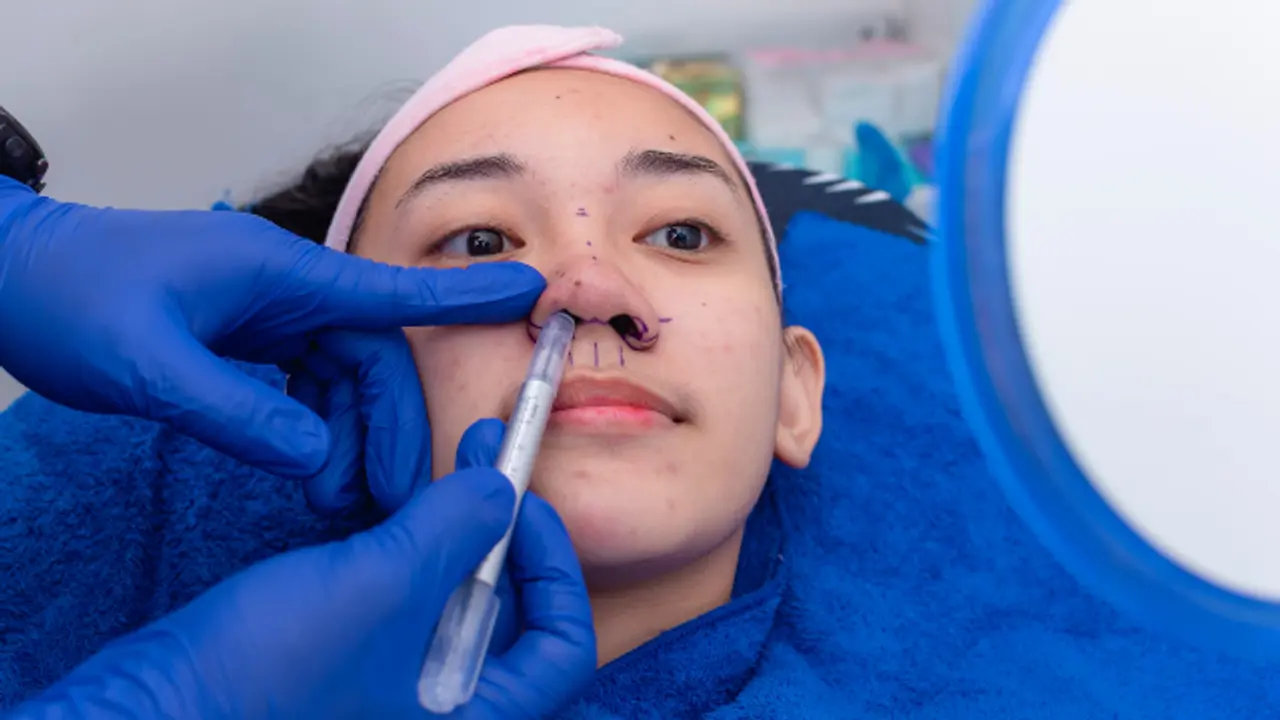
Septal Extension Rhinoplasty: Nasal Length & Tip Projection
Septal extension rhinoplasty uses your own cartilage to add nasal length and tip projection. Learn how it works, septum vs rib grafts, and who qualifies.
Learn More

Alar Reduction & Nostril Reshaping: Narrow a Wide Nasal Base
Alar reduction narrows a wide nasal base and reshapes flared nostrils. Learn how the technique works, scarring, recovery, and how a wide nose is assessed.
Learn More
Bulbous Nose Correction: Refining a Round Tip, No Implant
Bulbous nose correction refines a round nasal tip by reshaping your own cartilage, with no implant. Learn the techniques, candidacy, and recovery timeline.
Learn More